When I was 8 or 9 years old, I acquired a split beaver magazine. You can imagine my disappointment when, upon examination of the photos with a microscope, I found that all I could see was dots.
Malaclypse the Younger, Principia Discordia

When I was 8 or 9 years old, I acquired a split beaver magazine. You can imagine my disappointment when, upon examination of the photos with a microscope, I found that all I could see was dots.
The human soul is no more and no less than a suite of software running on wetware known colloquially as “brains”. Like I said, we’re made of meat.
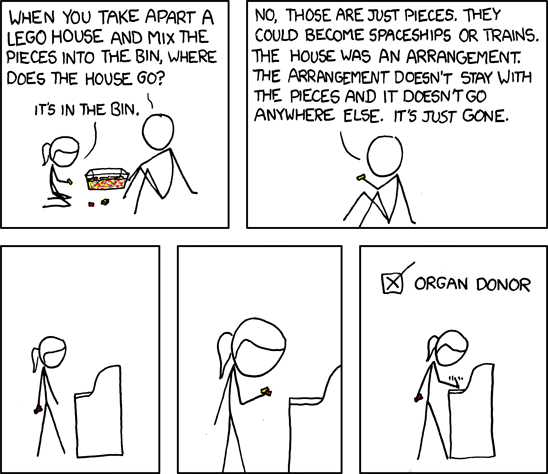
Or lego. Or matter. Or spirit. You see, it doesn’t matter what we’re made of. Because what we are is not what we’re made of. What we are is what we’re made into.
They’re made out of meat.
Meat?
Meat. They’re made out of meat.
Meat?
There’s no doubt about it. We picked several from different parts of the planet, took them aboard our recon vessels, probed them all the way through. They’re completely meat.
That’s impossible. What about the radio signals? The messages to the stars.
They use the radio waves to talk, but the signals don’t come from them. The signals come from machines.
So who made the machines? That’s who we want to contact.
They made the machines. That’s what I’m trying to tell you. Meat made the machines.
That’s ridiculous. How can meat make a machine? You’re asking me to believe in sentient meat.
I’m not asking you, I’m telling you. These creatures are the only sentient race in the sector and they’re made out of meat.
Maybe they’re like the Orfolei. You know, a carbon-based intelligence that goes through a meat stage.
Nope. They’re born meat and they die meat. We studied them for several of their life spans, which didn’t take too long. Do you have any idea the life span of meat?
Spare me. Okay, maybe they’re only part meat. You know, like the Weddilei. A meat head with an electron plasma brain inside.
Nope. We thought of that, since they do have meat heads like the Weddilei. But I told you, we probed them. They’re meat all the way through.
No brain?
Oh, there is a brain all right. It’s just that the brain is made out of meat!
So… what does the thinking?
You’re not understanding, are you? The brain does the thinking. The meat.
Thinking meat! You’re asking me to believe in thinking meat!
Yes, thinking meat! Conscious meat! Loving meat. Dreaming meat. The meat is the whole deal! Are you getting the picture?
Omigod. You’re serious then. They’re made out of meat.
Finally, Yes. They are indeed made out meat. And they’ve been trying to get in touch with us for almost a hundred of their years.
So what does the meat have in mind?
First it wants to talk to us. Then I imagine it wants to explore the universe, contact other sentients, swap ideas and information. The usual.
We’re supposed to talk to meat?
That’s the idea. That’s the message they’re sending out by radio. ‘Hello. Anyone out there? Anyone home?’ That sort of thing.
They actually do talk, then. They use words, ideas, concepts?
Oh, yes. Except they do it with meat.
I thought you just told me they used radio.
They do, but what do you think is on the radio? Meat sounds. You know how when you slap or flap meat it makes a noise? They talk by flapping their meat at each other. They can even sing by squirting air through their meat.
Omigod. Singing meat. This is altogether too much. So what do you advise?
Officially or unofficially?
Both.
Officially, we are required to contact, welcome, and log in any and all sentient races or multi-beings in the quadrant, without prejudice, fear, or favor. Unofficially, I advise that we erase the records and forget the whole thing.
I was hoping you would say that.
It seems harsh, but there is a limit. Do we really want to make contact with meat?
I agree one hundred percent. What’s there to say?” `Hello, meat. How’s it going?’ But will this work? How many planets are we dealing with here?
Just one. They can travel to other planets in special meat containers, but they can’t live on them. And being meat, they only travel through C space. Which limits them to the speed of light and makes the possibility of their ever making contact pretty slim. Infinitesimal, in fact.
So we just pretend there’s no one home in the universe.
That’s it.
Cruel. But you said it yourself, who wants to meet meat? And the ones who have been aboard our vessels, the ones you have probed? You’re sure they won’t remember?
They’ll be considered crackpots if they do. We went into their heads and smoothed out their meat so that we’re just a dream to them.
A dream to meat! How strangely appropriate, that we should be meat’s dream.
And we can mark this sector unoccupied.
Good. Agreed, officially and unofficially. Case closed. Any others? Anyone interesting on that side of the galaxy?
Yes, a rather shy but sweet hydrogen core cluster intelligence in a class nine star in G445 zone. Was in contact two galactic rotations ago, wants to be friendly again.
They always come around.
And why not? Imagine how unbearably, how unutterably cold the universe would be if one were all alone.
They’re Made Out Of Meat
by Terry Bisson
From “Bears Discover Fire and Other Stories,” Copyright © 1994, Tor Books
Used By Permission

Book Reveiw. http://undpress.nd.edu/book/P00167
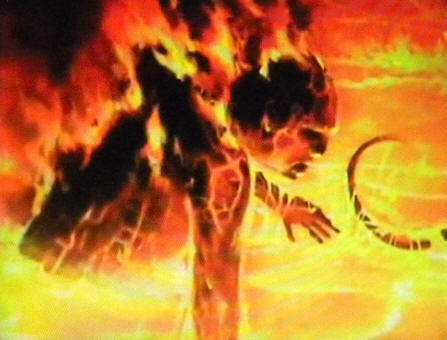
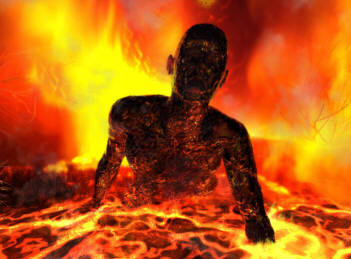
“Focusing on the issues from the standpoint of philosophical theology, Walls explores the doctrine of hell in relation to both the divine nature and human nature. He argues that some traditional versions of the doctrine are compatible not only with God’s omnipotence and omniscience, but also with a strong account of His perfect goodness.”
Reviews
“This book is a gem, clearly written and accessible to philosophers and non-philosophers alike. Within a fairly brief scope it covers the central issues and arguments relevant to its topic . . . Further, the book makes a case that universalists will find very hard to answer.” —Religious Studies
“Walls . . . does not think that because a culture trivializes the concept of hell it does not exist, nor does he think that belief in the existence of hell compromises belief in a good and loving God.”—Christian Century
“Hell: The Logic of Damnation is a forcefully argued reopening of questions that most liberal theologians had long thought to be decisively closed. . . . Jerry Walls has provided a bracing antidote to the moral frivolity and evil of our time.”—First Things
Sorry about this next one Richard. Get well soon Robin!
Are you lego or logos?
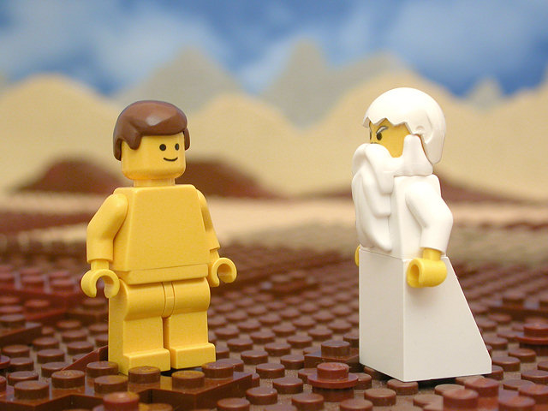
In the beginning was the Word, and the Word was with God, and the Word was God.
Philosopher Nicholas F. Gier explains the Logos Christology of the Gospel of John.
The famous prologue begins: “In the beginning was the logos, and the logos was with God, and the logos was God.” The standard English translation of logos is Word, following the basic meaning of lego as to say or speak. In other words, God is the author of the logic of the world, and his son is the expression of this logic. Furthermore, in the Genesis account of creation God speaks, or as Leonard Bernstein has suggested, sings the structure of the world into being. In Christian theology Christ is the one who orders the world; he is the one who puts it together, gives it meaning, and then redeems it from its fallen state. As Paul states: “For in him all things were created . . . and in him all things hold together” (Col. 1:16-17).
The etymology of the logos, the Greek word behind “reason” and “logic,” shows that the idea of synthesis is at the origin of these words. The Greek logos is the verbal noun of lego, which, if we follow one root leg means “to gather,” “to collect,” “to pick up,” “to put together,” and later “to speak or say.” We already have the basic ideas of any rational endeavor. We begin by collecting individual facts and thoughts and put them together in an orderly way and usually say something about what we have created.
There are three Reasons that I prefer Andrew Sullivan’s translation (and mine) of λόγος.
In the beginning was Reason, and Reason was with God, and Reason was God.
[Proudly powered by LOGOS™.]
“I am a Christian,” wrote Thomas Jefferson in a letter to Benjamin Rush.
To the corruptions of Christianity I am, indeed, opposed; but not to the genuine precepts of Jesus himself. I am a Christian, in the only sense in which he wished any one to be; sincerely attached to his doctrines, in preference to all others; ascribing to himself every human excellence; and believing he never claimed any other.
Was Jefferson a Christian? Discuss.
You may say, “It depends on what you mean by ‘Christian’,” but it doesn’t. Was Jefferson a Christian? The truth depends on historical facts about Jefferson and what he believed, not on contemporary facts about me and what I had in mind when I asked the question.
The meaning of a word depends on the conventions that govern its use.
I can use the word ‘Christian’ in an unconventional sense. But if I do, then until and unless my non-standard use of the word catches on and itself becomes part of the norm, there is a mismatch between what I say and what I mean. To take a different example, when Ayn Rand said that selfishness is a virtue, she did not mean what she said. (She said that selfishness is a virtue. But it’s not.) She did, however, say what she meant. (She meant that self-interest is a virtue. And it is.)
The conventions which govern our use of the word ‘Christian’ allow for more than one distinct sense of the word. For example, there are nominal Christians, cultural Christians, liberal Christians, fundamentalist Christians, practising Christians, denominational Christians, non-denominational Christians, and so on. But the conventions which govern our use of the word ‘Christian’ also determine a primary sense of the word.
Was Jefferson a real Christian? Discuss.

Specifically, are you a Christian libertarian think-fish? If so, then please join me in a new Christian libertarian think-tank.
Christian Choice will occupy space on the political spectrum above the Maxim Institute and half a dozen or so others and up a bit from the New Zealand Centre for Political Research and the newly fused New Zealand Initiative.

Please contact me with further details.
An excerpt from Richard Feynman’s What is Science?
Regarding this business about names and words, I would tell you another story. We used to go up to the Catskill Mountains for vacations. In New York, you go the Catskill Mountains for vacations. The poor husbands had to go to work during the week, but they would come rushing out for weekends and stay with their families. On the weekends, my father would take me for walks in the woods. He often took me for walks, and we learned all about nature, and so on, in the process. But the other children, friends of mine also wanted to go, and tried to get my father to take them. He didn’t want to, because he said I was more advanced. I’m not trying to tell you how to teach, because what my father was doing was with a class of just one student; if he had a class of more than one, he was incapable of doing it.
So we went alone for our walk in the woods. But mothers were very powerful in those day’s as they are now, and they convinced the other fathers that they had to take their own sons out for walks in the woods. So all fathers took all sons out for walks in the woods one Sunday afternoon. The next day, Monday, we were playing in the fields and this boy said to me, “See that bird standing on the stump there? What’s the name of it?”
I said, “I haven’t got the slightest idea.”
He said, “It’s a brown-throated thrush. Your father doesn’t teach you much about science.”
I smiled to myself, because my father had already taught me that [the name] doesn’t tell me anything about the bird. He taught me “See that bird? It’s a brown-throated thrush, but in Germany it’s called a halsenflugel, and in Chinese they call it a chung ling and even if you know all those names for it, you still know nothing about the bird—you only know something about people; what they call that bird. Now that thrush sings, and teaches its young to fly, and flies so many miles away during the summer across the country, and nobody knows how it finds its way,” and so forth. There is a difference between the name of the thing and what goes on.

What is Science? was presented at the fifteenth annual meeting of the National Science Teachers Association, in New York City (1966).
In a footnote to his paper God and Objectivism: A Critique of Objectivist Philosophy of Religion published in JARS, Stephen Parrish says
I find it difficult to ascertain exactly what Objectivists believe about the mind and the body. They reject substance dualism, yet also reject any sort of reductionism. It seems to me that their view of the mind-body relation is a sort of nonreductive physicalism. In this view, what really exists is matter—specifically, the brain, and the mind supervenes on, or is realized by the brain. This means that the mind does not exist apart from the brain, but cannot be reduced to it, by which it is meant that it cannot be totally explained in terms of the physical makeup of the brain. Writes William Thomas (n.d.a) on the mind-body relation:
What we call the mind is the set of capacities to be aware, to perceive the world, to think about it, to feel, to value, to make choices. How do these capacities arise? In many respects, the answer to that question must come from science, not philosophy. But everything we know indicates that they are the product of biological evolution and that they depend on our physical sense organs and brain, as well as on the many other support structures that the body provides.
Even the above, is not all that clear and could be interpreted in terms of either property dualism or nonreductive physicalism. I think that the latter fits in better with the overall picture of reality that Objectivists espouse. Actually, the mind-body problem is another area in which Objectivists need to work. …
Get to work, Objectivists!
Tell me, do you accept or reject substrate independence? Substrate independence is the claim that
conscious minds could in principle be implemented not only on carbon-based biological neurons (such as those inside your head) but also on some other computational substrate such as silicon-based processors.
In other words
what allows you to have conscious experiences is not the fact that your brain is made of squishy, biological matter but rather that it implements a certain computational architecture.
Do you accept or reject this claim?
[Cross-posted to The Third Watch.]
Over on my other blog (where I’ve wasted way too much time lately, but that stops right now) it’s often heard said (for example, right here) that
They who believe absurdities commit atrocities.
It’s often heard said to me. Apparently, I’m an apologist for irrationality, the epitome of stupidity and number among “they who believe absurdities”. Which, apparently, puts me on some sort of watch list. I’ll commit atrocities, for sure. It’s only a matter of time. Truly I tell you, I’m a ticking totalitarian time bomb!
In fact, belief in God is absurd. The Christian world view even more so. Tertullian, the early Christian writer who gave us the doctrine of the Trinity (the term does not occur in the Bible) is said to have argued, “Credo quia absurdum.” (“I believe it because it is absurd.”) I disagree with Tertullian. The absurdity (or otherwise) of Christian belief has no bearing at all on its truth or falsity. This is a point I want to return to in an upcoming post. All I’m saying now is, yes, I believe absurdities.
The belief that “they who believe absurdities commit atrocities” is itself absurd! And false. It’s axiomatic that all Christians sin. But few Christians commit atrocities. Most sins we commit are “venial” sins as the Catholics say, or “token” sins or “trifles” as Martin Luther put it. Not atrocities. The wages of sin is death. I sure as hell ain’t asking for a raise!
Charity is both a Christian virtue and an epistemic virtue, so I’m going to be charitable and assess the watered down claim that
They who believe absurdities are more likely to commit atrocities than those who don’t.
It’s an empirical claim. We have reason to believe it only if we have evidence that they who believe absurdities are more likely to commit atrocities than those who don’t. But we don’t. So it’s an irrational belief. (Stupid, too.) End of story.
Time for a quick sequel? The original saying is attributed to Voltaire, and I got to wondering if Voltaire actually said it. After all, he never said
I disapprove of what you say, but I will defend to the death your right to say it.
either. (That was Evelyn Beatrice Hall.) So I did some research. Here’s what Voltaire actually said.
They who can make you believe absurdities can make you commit atrocities.
And here’s what Voltaire said next.
If the God-given understanding of your mind does not resist a demand to believe what is impossible, then you will not resist a demand to do wrong to that God-given sense of justice in your heart.
Objectivists score own goal! Christians sit on sidelines and drink beer. Sounds good to me.
Time for a quick coda? If you do happen to be in the mood to commit an atrocity, but you’re short of ideas, look no further than your friendly, neighbourhood atrocity vendor. (Psst! Want some atrocities?) (I’m kidding. Thou shalt NOT commit atrocities. I hope I didn’t really need to tell you that. You came here from SOLO? Oh, okay.)
WARNING: The lyrics to the song below rank among the most violent, gruesome and sadistic that I’ve ever set ears on. They qualify as extremely gross even by death metal’s usual lyrical standards. Self-parody? You decide. Either way, the lyrics are testament to Slayer’s pure epicness. As one YouTube commenter remarks, “Wow if this isn’t genius what the hell is.”